Blog Posts Relating to:
Full-Service Billing
Surgery Billing – A Guide to Medicare’s Global Surgery Package

When it comes to medical billing for surgery, there are various claim submission requirements within Medicare. The largest and most broadly applied is called The Global Surgery Package, or more simply, Global Surgery.
Global surgery refers to all the necessary services performed by a surgeon before, during, and after a surgical procedure. It also includes any necessary services performed by members of that surgeon’s team (provided they practice within the same specialty).
Medical Billing Rates – What Prices to Expect for Specific Billing Services
The most common question medical billing companies hear: “What are your prices?”
It’s a perfectly reasonable question. Price is a major factor in any business decision. Plus, medical billing company rates aren’t exactly readily available—and when rates are listed, they are often vague or misleading.
In this article, we’ll clear up the confusion surrounding medical billing service rates. We’ll also break down what specific services to expect for a given price, along with the key factors that determine those rates.
Wondering what price you should expect for the specific billing services you need?
Background: What Has Led to Current Industry Rates?
Medical billing companies have existed for decades, but over the past 10 years, the industry’s business model has shifted dramatically. This change comes down to two main drivers:
1) Industry Growth
Growth in the medical billing industry stems from technological advances and regulatory changes—specifically, complex coding requirements (ICD-10), privacy regulations (HIPAA, HITECH Act), and expanded adoption of Electronic Health Records (EHR). As billing has grown more intricate, practice demand for third-party billing specialists has skyrocketed.
2) Consolidation
Like the broader healthcare sector, medical billing has experienced significant consolidation. Small, local billing companies once dominated the market. While still common, their market share decreased as large EHR software providers entered the billing space, attempting to automate revenue cycle management with bargain rates. While full automation largely failed, their entry permanently altered pricing expectations across the board.
The Effect: Growth and consolidation have created a more competitive, lower-cost market. While rates have dropped significantly from historical double-digit percentages, the challenge for practices today is ensuring they still receive the high level of service they expect.
Where do current medical billing prices stand?
The Simple Answer: Typical advertised rates range from 3% to 8% of collections.
The Real Answer: Modern pricing structure depends heavily on your practice volume, specialty, and the exact scope of services included.
Medical Billing Prices: The Reasons Behind the Wide Range
Medical billing pricing typically hinges on two key factors:
1) The Attributes of the Client
Practice characteristics heavily dictate quote variations. Certain client profiles require significantly more labor and specialized attention from a billing team. Below are the key attributes billing companies analyze:
In short, uniform workloads are easier to manage. A multi-state, multi-specialty practice interacts with dozens of payer rules and regulations, requiring a larger, highly experienced billing team. Consequently, multi-faceted practices reflect higher service rates.
2) The Specific Services Provided
Rates directly correspond to service scope. Companies charging 3% to 4.5% typically offer minimal, baseline processing (often offshored), leaving tasks like appeals, credentialing, and patient inquiries to your internal staff. Conversely, rates in the 6% to 8% range encompass comprehensive, end-to-end revenue cycle management.
Key considerations when evaluating service level:
- Do you require help with coding, claims appeals, credentialing, or patient collections?
- Does your practice need assistance with MIPS, HIPAA compliance, or pre-authorizations?
- Do you require dedicated, U.S.-based account managers for client communication?
- Are you retaining your existing EHR software or adopting a new system?
Core Revenue Cycle Services to Compare:
- Charge entry & claim submission
- Payment posting & Accounts Receivable (A/R) management
- Denial management & claims appeals
- Credentialing, enrollment & MIPS support
- Patient billing inquiries & data analytics
Average Medical Billing Rates: What to Expect
Based on our 15+ years in the RCM industry, rates align closely with the depth of support provided:
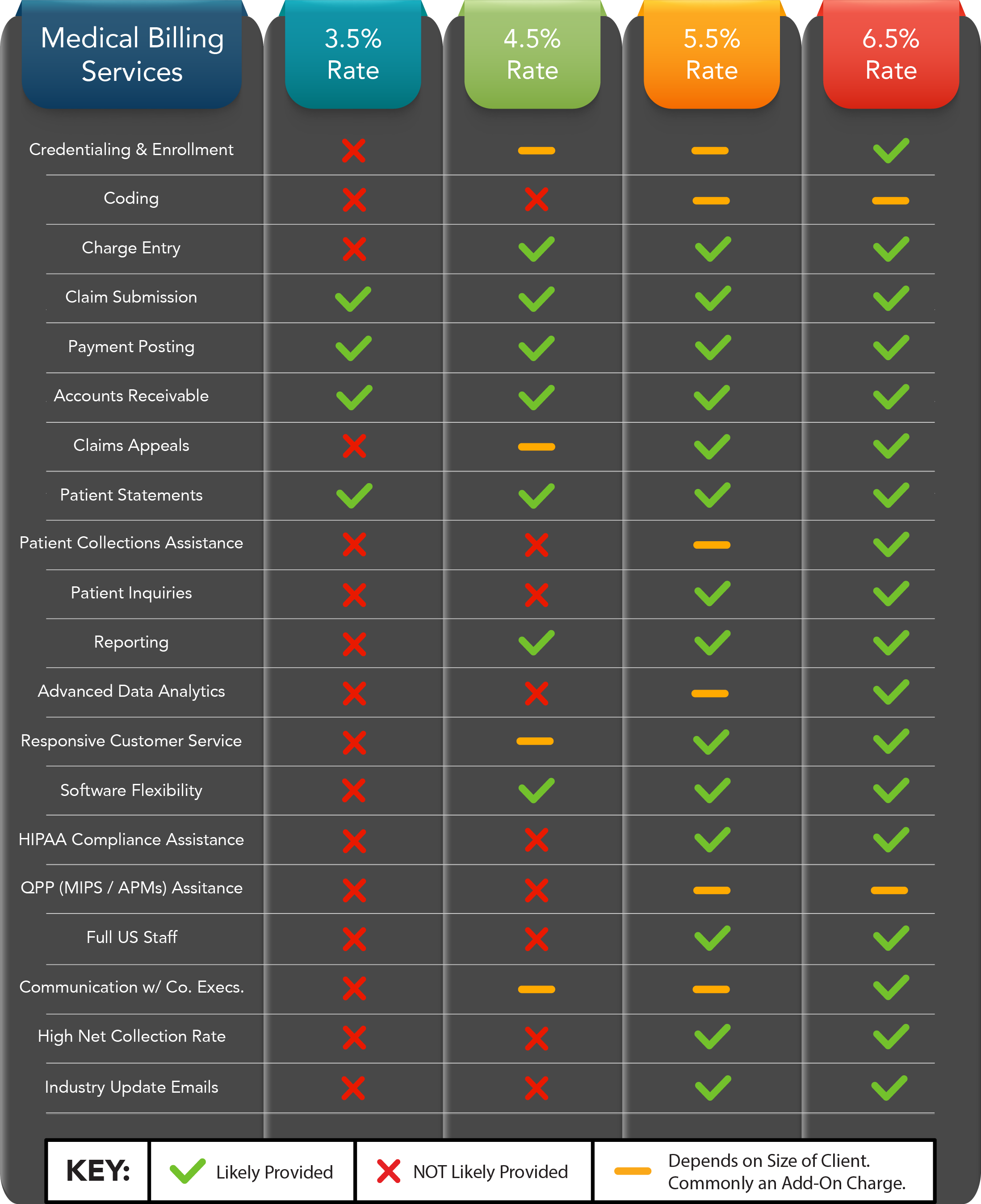
Average expected pricing tiers based on comprehensive vs. baseline billing service models.
Summary Takeaway: Bargain rates often mean hidden costs down the road in the form of unresolved claim denials or slow customer service. When negotiating with billing providers, align your decision with your practice’s operational goals: whether that means securing baseline claim processing or partnering with a full-service team that actively optimizes your revenue cycle.
MIPS Participation Guide for 2018

The purpose of this post is to walk you everything you need to know in order to successfully participate in MIPS for the 2018 performance year. Whether you’re relatively fluent in MIPS or a complete beginner, we hope you’ll leave with a general understanding of the MIPS system and what’s required of you.
If you’re completely new to MIPS, check out the following links before reading the remainder of this article.
- Our MIPS Page: Contains a general explanation of MIPS, along with information about who must participate in 2018, the evaluation criteria (Performance Categories), and Reporting Options for providers
- MIPS 2018 Overview and Assistance: A blog post containing information about MIPS 2018 eligibility, exemptions, and logistics
How to Find and Choose the Best Medical Billing Company Online
Here at Valletta, we constantly strive to meet the true needs of medical providers. While not every provider shares the same set of needs, there are a few basic factors that most clinicians agree are essential to a successful billing program. To name a few:
- Collect maximum fair reimbursement
- Get rid of mistakes and inefficiencies
- Have smooth, timely patient payments (and payer reimbursement)
- Receive clear revenue cycle data for proper business evaluation
- Receive informed, responsive customer service from biller
- Be able to customize billing services to address specific needs
While there are many other factors to competent billing, most physicians share these common goals. The difficult part is figuring out how to achieve them. For those looking to outsource their revenue cycle, researching billing companies online can be a pain. How do you know if a specific company is capable or trustworthy? In the following paragraphs, we provide some tips to help you more successfully distinguish between the various types of RCM companies online.